


Your product can be great. Your shopify store can look amazing. But if shoppers can't get help when they need it, they won't come back.
In 2026, customers expect fast, personal support across every channel be it email, live chat, or a call. One bad experience not only leads to a bad review, but a chargeback, and a lost customer and that that honestly compounds quickly.
In this blog, I've tried to cover everything you’ll ever need as a shopify brand to build a support operation that actually works:right from the support channels, the right tools, how to measure what matters, and when outsourcing makes more sense than hiring. By the end, you'll have a clear picture of where and what to start and prioritize.
Why Support Quality Directly Affects Ecommerce Revenue
Most Shopify owners think of support as a cost. The data we found on Microsoft however says otherwise.
96% of consumers say customer service influences their loyalty to a brand. And retaining an existing customer costs 5x less than acquiring a new one. That means every ticket your team handles well is a is a customer retained for life and not just a ticket simply resolved.
Here's what happens when support is strong:
- Churn drops because frustrated customers have somewhere to turn before they leave
- Refund and chargeback rates fall because issues get resolved before they escalate
- Repeat purchase rates go up because customers trust the brand, not just the product
- Reviews skew positive because people remember how problems were handled
Shopify brands doing this well don't treat support as a department that puts out fires by resolving tickets. They treat it as part of the customer experience. Delivering the best ecommerce customer experience isn't just about having agents who can reply faster. It's also about building a system where support reflects the same care and quality as the product itself.
That shift in thinking changes how you hire, what tools you invest in, and how you measure success.
How to Build a Support Operation That Actually Works
Most ecommerce support problems come from the same root causes: no clear ownership, no documented process, and tools that don't talk to each other. Here are a few strategies to build a support operation that actually works:
1) Get Your Support Channels Right First
Shoppers don't just email anymore. They DM on Instagram, message on WhatsApp, and comment on ads. You need to be reachable wherever your customers already are, but you don't need to be everywhere at once.
Start with the Support channel that matches your customer base:
- Live chat is now the most-used support channel for ecommerce. Customers expect a reply in under two minutes. If they wait longer, most will abandon the cart.
- Email is still essential for post-purchase queries: order tracking, returns, and refunds. The benchmark for competitive brands is a response within four hours.
- Social DMs on Instagram, Facebook, and TikTok are growing fast. If you sell on those platforms, you need to respond there. Ignoring DMs is the same as leaving your phone off the hook.
- WhatsApp and SMS work well for high-intent buyers and order update notifications. Brands using WhatsApp for support see significantly higher open and resolution rates compared to email.
- Phone still matters for high-value orders and customers who just want to talk to someone. It builds trust quickly when something goes seriously wrong.

You don't need all 5 support channels from day one. Pick the two or three where your customers actually are, do those well, and expand from there.
2) Use a Shared Helpdesk So Nothing Falls Through
The single biggest operational mistake most Shopify brands make is managing support across 5 different tabs. Shopify notifications, Gmail, Instagram DMs, WhatsApp, it becomes unmanageable super fast. Tickets get missed, Customers follow up a 2nd time,and that is when the trust breaks.
A shared helpdesk like Gorgias, Zendesk, or kim.cc helpdesk pulls every conversation into one place. Agents can see the customer's order history, assign tickets to teammates, and track SLAs without switching tools. These tools are particularly strong for Shopify brands because agents can process refunds, update shipping addresses, and cancel orders directly from the ticket view.
If you have more than two people touching support, a shared helpdesk isn't optional. It's quite literally the foundation everything else sits on.
3) Stop Waiting for Customers to Come to You
A big portion of your inbound ticket volume is predictable questions like"Where's my order (WISMO)?" alone can account for 30-40% of total tickets for some brands. You can eliminate most of these before they're ever sent.
Send automated shipping updates at every stage: confirmed, shipped, out for delivery, delivered. Set up post-purchase flows that proactively address the most common questions for your product category. If your product has a learning curve, send a setup guide before customers need to ask.
This is what separates good ecommerce support from great. The best teams aren't just fast at responding. They're smart about what never needs a response in the first place.
4) Train Agents on Your Brand, Not Just Your Policies
Generic support doesn't work anymore. A script that could apply to any store will sound like it applies to no store. Customers pick up on that immediately.
Your agents need to know your actual catalog. They need to understand your return policy well enough to explain the edge cases, not just quote the headline rule. They need to know your brand voice so their replies feel like they came from someone who works there.
This applies whether your team is in-house or outsourced. The training investment is the same either way. The brands with consistently high CSAT scores understand that customer service in ecommerce is only as good as the people and processes behind it. They spend real time onboarding agents to the brand, not just the ticketing system.
AI and Chatbot SupportTools for Ecommerce worth exploring in 2026:
A well-configured customer support chatbot for ecommerce brands can handle 50-70% of queries like "WISMO" without a human agent touching it. That means answering order status questions, sharing return policy information, processing straightforward exchanges, and routing complex issues to the right person.
The key word is "well-configured." A chatbot that gives wrong answers or dead-ends customers into a frustrating loop does more damage than no chatbot at all. One of the customer service best practices in eCommerce that gets overlooked here is making sure your bot has a clean escalation path to a human agent when it can't help.
Support Tools worth evaluating for this:
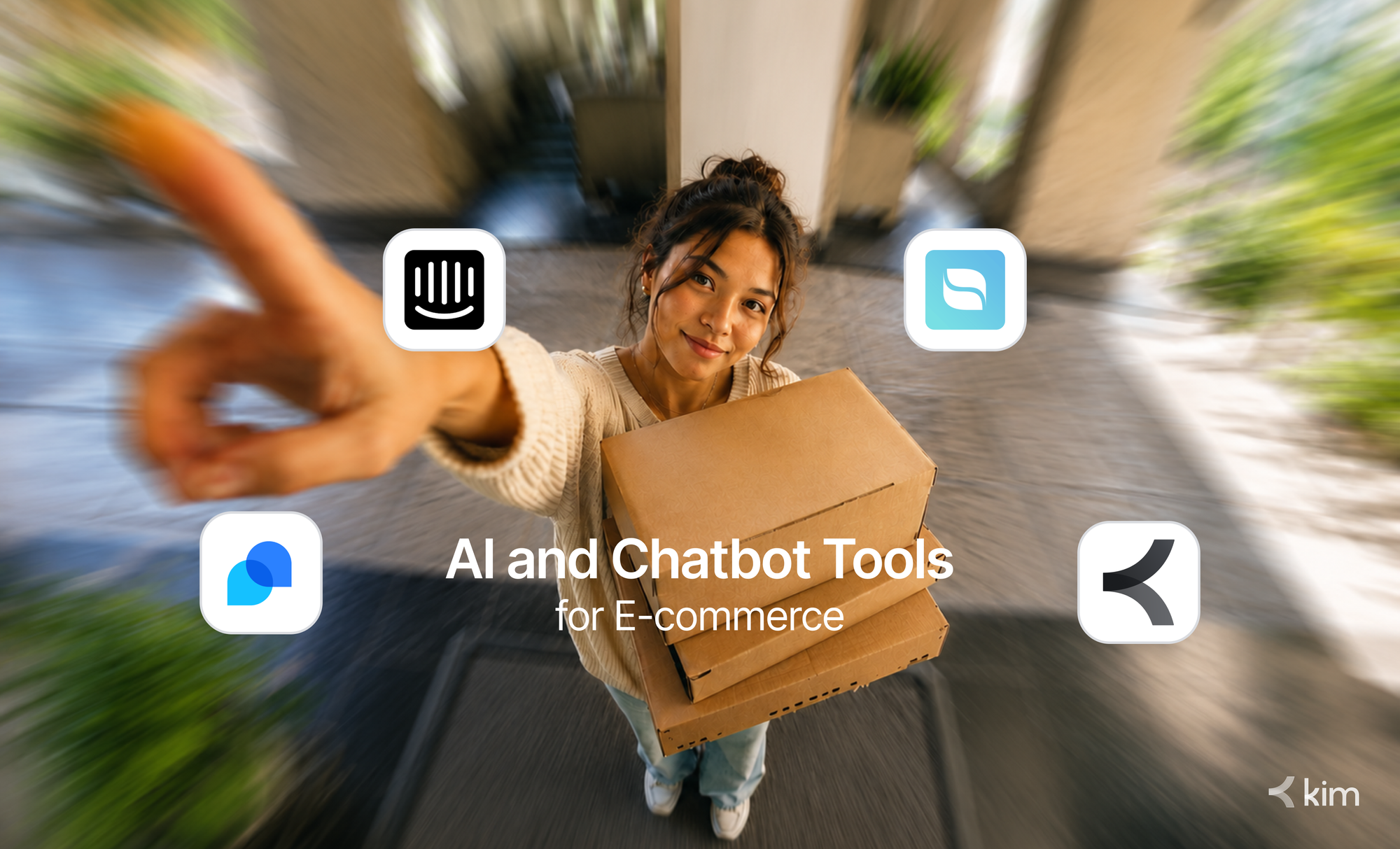
- Tidio is affordable, Shopify-native, and easy to set up for smaller teams
- Intercom is more powerful for brands with complex support flows and higher volume
- Re:amaze combines a shared inbox with bot functionality, which works well for DTC brands that want both in one tool
- kim.cc takes a different approach where AI handles the volume, but trained human agents review responses before they go out. You get the speed of automation without the risk of a bot saying something off-brand. Over 200 Shopify brands now run their support this way.
The right choice depends on your volume, team size, and how much customization you need. But if you haven't added any automation to your support operation yet, that's the highest-leverage place to start.
When to Outsource Your Ecommerce Customer Support
At some point, most growing Shopify brands hit the same wall where their Support volume is outpacing the team's capacity, Coverage gaps are appearing afterhours and weekends, BFCM is coming and there's no clear plan for the ticket spike.
That's usually when outsourcing becomes worth a serious look.
What Outsourcing Actually Solves
Ecommerce customer service outsourcing solves three specific problems well:
- Coverage -- You get 24/7 support without building a round-the-clock internal team
- Scalability -- You ramp up for BFCM and scale back down in January without the hiring and layoff cycle
- Cost -- Offshore or nearshore agents typically run 40-60% less than equivalent in-house hires
What it doesn't automatically solve is quality. That comes from picking the right partner.
What to Look for in an Outsourcing Partner
Not all outsourcing is the same. Generic BPOs that handle dozens of industries will give you generic results. The most reliable e-commerce customer service comes from partners who specialize in it. You want someone with specific ecommerce experience and ideally Shopify familiarity.
When you're evaluating options, ask for:
- CSAT scores from existing ecommerce clients
- Evidence they've worked with your helpdesk tool before (Gorgias, Zendesk, kim.cc etc.)
- A clear onboarding process that covers brand voice, not just policy documents
- Transparent pricing with no hidden setup fees
- A trial period before any long-term commitment
A good outsourced team should be indistinguishable from an in-house one. Customers should feel like they're talking to someone who actually knows the brand.
The Metrics That Tell You If Your Support Is Working
Tracking ticket volume tells you how busy your team is. It doesn't tell you if they're doing a good job. These are the numbers that actually matter.
1) First Response Time (FRT) measures how long it takes to send the first reply after a ticket is opened. For live chat the target is under two minutes. For email, under four hours. Missing these benchmarks consistently is the fastest way to lose customer trust.
2) First Contact Resolution (FCR) measures how often a ticket gets fully resolved in a single interaction, without the customer needing to follow up. High FCR means your agents have the right information and authority to actually solve problems. Low FCR usually points to either poor training or agents who can't make decisions without escalating everything.
3) CSAT (Customer Satisfaction Score) is the direct measure of how customers feel after an interaction. Aim for above 4.5 on a 5-point scale. Anything below 4.0 warrants a close look at what's going wrong.
4) Average Handle Time (AHT) measures efficiency. It's useful for spotting agents who are spending too long on straightforward tickets, or identifying ticket types that need better macros or documentation to speed up.
5) Churn Rate is the long-term outcome metric. If your support is genuinely good, churn should decline over time. If it's going up despite strong acquisition, support is often a contributing factor worth investigating.
Review these weekly, not monthly. Small problems are easy to fix. The same problems six weeks later are not.
FAQ
1) What is ecommerce customer service?
It's the support you provide to online shoppers before, during, and after a purchase. It covers channels like live chat, email, phone, and social media, and it spans everything from pre-sale questions to post-purchase issues like returns and refunds.
2) How do I improve customer service in my ecommerce store?
Start with response time. That single metric has the highest impact on customer satisfaction. Then look at deflection: what percentage of tickets could have been prevented with better proactive communication? Fix those two things and you'll see measurable improvement fast.
3) Should I outsource ecommerce customer support?
Outsourcing makes strong sense if you're struggling with coverage gaps, scaling costs, or handling peak-season volume. The key is finding a partner with real ecommerce experience, not just a general BPO. Ask for CSAT data and a trial period before committing.
4) What tools do I need for ecommerce support?
At minimum, a shared helpdesk (Gorgias or Zendesk) and some form of automation for high-volume repetitive queries. As you scale, add structured escalation paths, a knowledge base for agents, and CSAT surveying after every interaction.
5) What metrics should I track?
First Response Time, First Contact Resolution, CSAT, and Average Handle Time. Together those four give you a complete picture of both speed and quality.
6) How many support agents do I need?
A rough benchmark is one full-time agent per 150-200 tickets per day. Plan for a 3-5x volume spike during BFCM and have a coverage plan ready before the season starts, not during it.
Conclusion
Good support doesn't just fix problems. It builds the kind of trust that turns one-time buyers into repeat customers.
The brands getting this right in 2026 aren't necessarily the ones with the biggest teams or the most expensive tools. They're the ones with clear processes, agents who know the brand, and metrics they actually review and act on.
Start with the fundamentals: a shared helpdesk, fast response times, and proactive communication that prevents tickets before they're sent. Then layer in automation and outsourcing as your volume grows.
If your team is already stretched thin and coverage gaps are costing you, you don't have to build this from scratch. Book a demo with kim.cc and see how 200+ Shopify brands are running 24/7 support without the overhead of a full in-house team.


